Dining ‘al fresco’ in Oakleigh.

It’s noisy. There’s a general cacophony of people talking and laughing and the clatter of cups, plates and cutlery. Numerous cafes and restaurants, small shops, and several bakeries selling traditional Greek cakes and pastries line the street. The luscious aromas of coffee and souvlaki meats waft in the open air, interrupted from time to time by an acrid whiff of cigarette smoke from a diner at an open-air table. Smoking anywhere in public seems so out of place these days.

A well-dressed woman walks by, her expensive perfume lingering in the air after her. I wonder how much fragrance one needs to apply in order to have that effect.

The service is not terribly quick here, but I think that is related to how Greeks view eating and mealtimes: it’s about enjoying food, sharing conversation and spending time together.

In time, our meals arrive. Freshly prepared, beautifully presented and absolutely delicious. I enjoy every mouthful, but I am glad I didn’t order anything more.

Sated, I walk away enjoying the light breeze and the sunshine on my shoulders.

Waiting Room.

The Alfred Hospital in Melbourne does some fabulous work in healing and restoring sick and broken bodies. It’s been here since 1871 and still has some beautiful Victorian staircases and hallways.

I’ve been spending a lot of time in the waiting area of the ICU this weekend with family.

It’s one of those places where everyone is truly equal. Grief is impartial: it doesn’t care if you’re rich, or beautiful, or not. None of that matters when you’re on your knees and you’re contemplating a future that is significantly different than you had thought it would be.

There are so many stories here of sadness and brokenness, of fear and loss and sorrow. So many tears.
It’s where people gather for waiting, crying and decision making. The prayers said here are probably more heartfelt and genuine than many of those said in churches on any given Sunday.

I wouldn’t wish this on anyone. Not ever.

Posh.

High-walled gardens and tree-lined paths. Private mansions. Beautifully presented low-rise apartment blocks. Smartly dressed people walking briskly in the soft rain when they alight from the tram. Maseratis and Alfa Romeos parked by the kerb.

“I think there’s some money here,” says my brother-in-law from the back seat.
“You think?” I reply.

We drive on.

Port Fairy.

The weather today was perfect  for a visit to Port Fairy, a beautiful little town on the south-western coast of Victoria, Australia. The sun was shining, there was a very slight breeze, and it was a glorious 19 degrees Celsius.

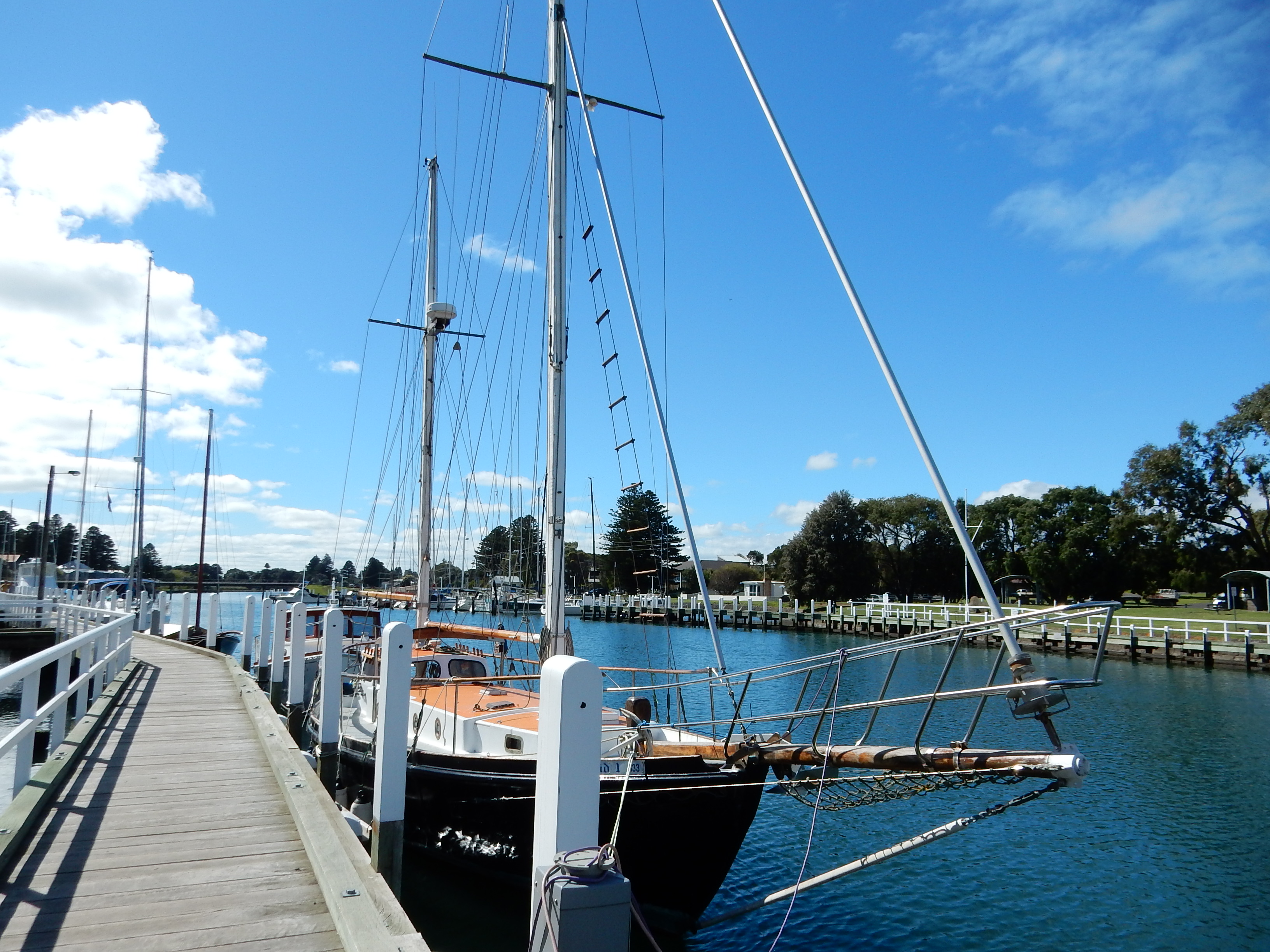
I walked slowly along the boardwalk which extends along the bank of the Moyne River, where the fishing boats moor. The water sparkled, lapping against the banks and the boats as we walked and enjoyed the scenery. Boats bobbed.  Seagulls hovered and swooped. Fishermen tended to their boats and chatted with people as they passed by. Two teenagers enjoyed the sunshine, sitting on the side of the boardwalk and dangling their feet over the water, holding hands and chatting happily.

I made my way to the main street of town, where small shops offer their wares, cafes invite visitors to enjoy coffee, cake or ice-cream, and everything has a rustic feel to it. There are no department stores or fast food chains here.  The cafes sell food that is made on the premises. There are two bookshops – I believe that this is always a very good recommendation for any town. Other shops sell handcrafted gifts, boutique clothing or old-fashioned sweets. The supermarket still has staff that will carry your bags to your car for you.

Whenever I visit Port Fairy, I visit Rebecca’s Cafe. The freshly baked cakes and slices are mouth-wateringly good, and their thickshakes are incredible. The coffee here is also excellent. However, those aren’t the only reasons I visit here. I visited here shortly after the passing of my beautiful friend, Rebecca. She wasn’t connected with the cafe or the town in any way, except by sharing the name, but it occurred to me then that she would have loved the place, too, and the connection has stayed with me ever since.

Many of the buildings and houses in Port Fairy date back to the early years of the settlement that was originally named Belfast by its strongly Irish population. They add to the strongly reminiscent sense of days-gone-by that characterises the township. It may seem odd that a place can be rather old-fashioned and quite up-to-date at the same time, but this beautiful town manages to achieve that balance very nicely.

Moyne River, Port Fairy, Victoria.

Moyne River, Port Fairy, Victoria.
Photograph is copyrighted by the author of this blog.
Observations from beside the hospital bed #8 + Things I wish I hadn’t seen #2

When a gentleman is in a shared ward and has donned a theatre gown in readiness for surgery that afternoon, he should keep his legs together and flat on the bed at all times unless covered by a sheet or blanket.
Otherwise, the innocent and demure wallflower sitting beside her husband across the room may see things that cannot be unseen.
Said gentleman may be thankful that said wallflower keeps her amusement to herself.

Poor bloke.
Really.

Another first.

Today, I watched a guy vaccuuming the ceiling.
I grew up with a Dutch grandmother and I have had a Dutch mother-in-law for almost 25 years. Dutch women are notorious for being obsessive about cleaning, but I’ve never seen that before.

Things I wish I had never seen #1

There is an enormous man in the next room. Eeeeeenormous.
As I walked past, he was clearly visible: sitting on the side of his bed eating breakfast, wearing nothing but shorts.

That is, I assume he was wearing shorts.
I hope he is wearing shorts.
I couldn’t actually see them.

There are some things you simply cannot unsee.

Observations from beside the hospital bed #4

Let me start by saying this is NOT about my husband. It’s about behaviour I have witnessed in other people over the past two days.

When a cardiologist performs an angiogram and then gives a diagnosis that a patient’s condition is very serious, and he has 90% blockage in the main coronary artery, you should probably believe them, especially if neither of you have any medical training or experience.

When they tell you that you need a six-way bypass, you shouldn’t google the patient’s condition, find an alternative treatment that isn’t available in your country because it’s highly experimental, and try to tell the doctor that he wants that treatment instead.

When the doctor returns with a Professor of Cardiology for reinforcement, you shouldn’t try to tell the Professor that he is wrong.

When you do not just one, but all, of these things, the people who witness what you say and do are going to decide that you are a very arrogant and very special kind of stupid.